
The 5 Skills Needed to Become an AI Operator

Danielle Dobinson
&
.jpg)
No items found.
AI tools are getting smarter, faster, and more accessible every day and businesses aren't being shy about adopting them.
According to McKinsey's 2025 State of AI survey, 78% of organizations now use AI in at least one business function, and 71% regularly use generative AI somewhere in their business. It’s safe to say that AI adaption is no longer a rarity but the norm.
AI adoption doesn't automatically mean that proper foundational practices are in place to support successful implementation. For example, only 25% of large organizations have a clearly defined roadmap for AI adoption, 31% provide AI training, and 18% have defined KPIs for adaption. The numbers are even lower among smaller organizations.
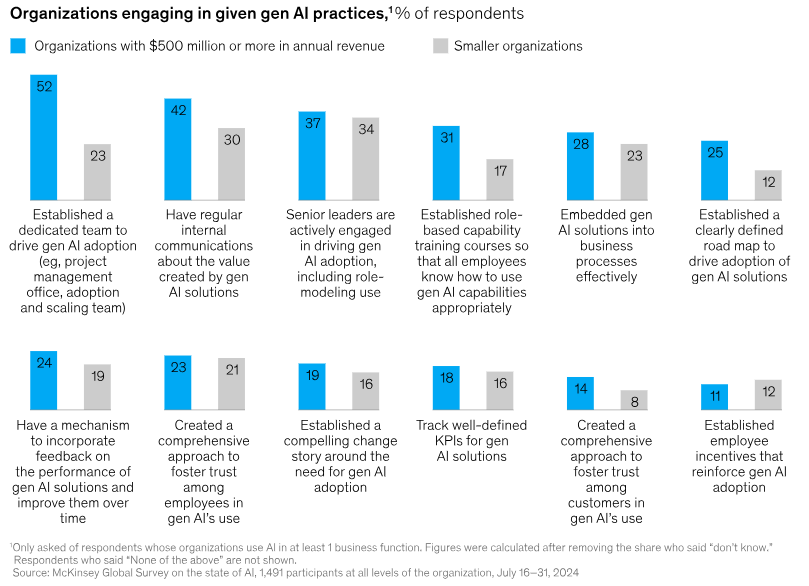
The AI Skills Gap Nobody Is Talking About
It’s clear that as more organizations experiment with AI, one challenge keeps emerging: most teams don't struggle because they lack AI tools, they struggle because they lack a process for using them effectively.
That's creating a demand for a new type of professional: the AI Operator.
An AI Operator isn't necessarily a developer or data scientist. They're someone who can understand a business process, identify where AI can help, build repeatable workflows, and ensure teams actually adopt them.
In fact, AI Literacy’ was ranked LinkedIn's #1 fastest-growing skill in 2025, signaling a need for professionals who can successful connect AI technology and adoption with business goals.
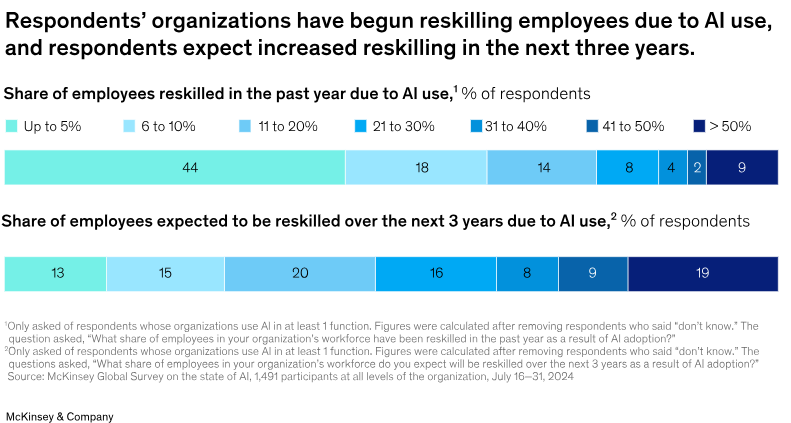
McKinsey found that companies are already reskilling employees because of AI, and respondents expect those efforts to significantly increase over the next three years.
At Brandience, a full-service marketing agency, we've spent the last several years exploring how AI can make our team smarter, faster, and more effective in a human-centered, AI forward approach.
As I've worked through the AI Operator Certification from The AI Exchange, one thing has become clear: successful AI implementation relies less on technical expertise and more on a handful of foundational skills.
To successfully lead AI implementation, improve AI adoption, and build scalable AI workflows, these are the five foundational AI skills:
- Process Thinking
- Prompt Engineering
- Systems Design
- Critical Thinking & Evaluation
- Change Management & Adoption
Skill #1: Process Thinking
Great AI Starts with Understanding the Workflow
One of the biggest misconceptions about AI is that it can fix broken processes. In reality, AI tends to expose them. Much like AI can amplify poor data quality rather than correct it, it can also magnify inefficient workflows and operational bottlenecks
Before an AI Operator ever opens ChatGPT, they need to understand:
- How work is currently being done
- Where bottlenecks exist
- What inputs are required
- What successful outputs look like
This is the first phase of the CRAFT Cycle™, called Clear Picture.
Skill #2: Prompt Engineering
AI Is Only as Good as the Instructions It Receives
Most people have experienced it: You ask AI a question and get a generic answer. It's also why what we call “prompt-and-pray". When prompts lack context, criteria, and clear direction, AI fills in the gaps, sometimes with not great outputs.
Then you ask the same question with better context and suddenly the response is dramatically better. That's called prompt engineering.
One framework we use throughout the certification is called the MASTER Method, which encourages operators to provide:
- A clear role
- Context
- Criteria
- Response format
- Examples
- Instructions
The difference is significant. The best AI Operators don't simply ask better questions. They create better instructions. And that directly supports the next two stages of the CRAFT Cycle™:
- Realistic Design
- AI-ify & Automate
Once you understand the process, the next step is defining it clearly enough for AI to perform part of the work. This requires documenting the knowledge, rules, and decision criteria that experienced team members use every day and converting them into instructions AI can consistently follow.
Being an AI Operator is often less about mastering technology and more about turning individual expertise into a repeatable process.
Skill #3: Systems Design
AI Tools Create Outputs. Systems Create Results.
McKinsey's research reinforces an important point: organizations don't need more AI tools. They need better systems.
A certified AI Operator thinks beyond individual prompts and starts asking:
- What triggers this workflow?
- What information do we need?
- What should AI do?
- What should humans still do?
- How will quality be measured?
This is where the CRAFT Cycle™ becomes especially valuable. Rather than treating AI as a standalone tool, it encourages operators to build workflows that connect. The formula to this thinking looks like:
People + Process + Technology
This mindset shift is how you move from random experimentation to repeatable business outcomes.
Skill #4: Critical Thinking & Evaluation
AI Doesn't Think—It Predicts
One of the most important lessons from the certification is understanding what generative AI actually is. Large Language Models aren't reasoning like humans. They're predicting. That means AI can generate outputs that sound convincing, even when they're incomplete or incorrect.
An AI Operator's job isn't just generating answers, but evaluating them. This becomes especially important during the Feedback stage of the CRAFT Cycle™.
Strong AI Operators constantly ask:
- Is this accurate?
- Is this useful?
- Does it meet business requirements?
- How can we improve it?
Feedback isn't a sign something failed. Feedback is how the system improves.
Skill #5: Change Management & Adoption
The Best AI Workflow Is Useless If Nobody Uses It
This may be the most underrated skill of all. Organizations often focus heavily on building AI solutions and very little on adoption.
The final stage of the CRAFT Cycle™ is Team Rollout, because success ultimately depends on people.
AI Operators must consider:
- Training
- Documentation
- Feedback loops
- User experience
- Ongoing support
The reality is simple: Even a great AI workflow creates no value if it never becomes part of someone's daily process. That's why AI Operators spend as much time thinking about people as they do technology.
Final Thoughts: AI Operators Will Bridge the Gap Between AI and Business
As AI continues to evolve and adoption among businesses continue to increase, the most valuable professionals in the market won't simply be the people who know how to use AI tools. They'll be the people who know how to turn AI into measurable business outcomes.
That requires the five foundational AI skills:
- Process thinking
- Prompt engineering
- Systems design
- Critical thinking
- Change management
In other words, it requires becoming an AI Operator. And perhaps the biggest lesson I've learned so far is this: AI isn't replacing strategic thinking. It's raising the importance of it.
About the Author:
Danielle Dobinson is a Media Planner & Buyer at Brandience, where she bridges client goals and media execution with enthusiasm and dedication. Also, a passionate AI enthusiast, she also co-leads the AI Hub at Brandience, a cross-disciplinary team of strategists, creatives, and analysts who ensure that artificial intelligence is thoughtfully integrated across every department. Connect with Danielle: https://www.linkedin.com/in/danielle-dobinson/
.jpg)
.jpg)

.jpg)
.jpg)