.jpg)
Understanding the Full Patient Acquisition Funnel

Bill Brassine
&

No items found.
Many patient acquisition strategies begin when a patient searches for care. It’s a common assumption: they identify a need, search for a provider in Google, and schedule an appointment.
In reality, long before a patient types “primary care doctor near me” into Google they’ve been influenced by many interactions that shape awareness, familiarity, and trust. They may have seen a television commercial, heard a radio spot, encountered social content, received a physician referral, or heard a recommendation from a loved one.
Understanding the modern patient journey helps healthcare organizations focus on the touchpoints that influence patient decisions, which is a core component of an effective patient acquisition marketing strategy.
Patient Acquisition Marketing with a Retail Lens
To understand the modern patient journey, it's important to first understand how patient expectations have evolved. One of the most significant shifts shaping healthcare marketing today is the retailization of healthcare.
The retailization of healthcare reflects a fundamental shift in how patients engage with care. Patient expectations are being shaped by the seamless, personalized interactions they encounter in every aspect of daily life. Consumers can order groceries with a tap, compare financial products in minutes, and schedule services instantly.
As those experiences become the norm, healthcare organizations are facing growing expectations for similarly accessible and convenient interactions. The rise of telehealth, online scheduling, digital pharmacies, patient portals, and on-demand care reflects a broader shift toward patient-centered healthcare.
Patients now expect:
- Convenience
- Transparency
- Personalized experiences
- Accessible information
- Digital experiences
This shift is changing how healthcare marketers think about visibility, access, and engagement, requiring organizations to show up in the channels where patients discover, research, evaluate, and choose care.
Understanding How Patients Book Appointments
Search plays a critical role in modern patient acquisition. For many consumers, a healthcare journey begins with a question, symptom, condition, or provider search. In fact, search engines are the leading provider discovery source among adults under 55, with 31% to 33% of consumers ages 18-34 and 27% to 32% of consumers ages 35-54 reporting search as their primary discovery driver.
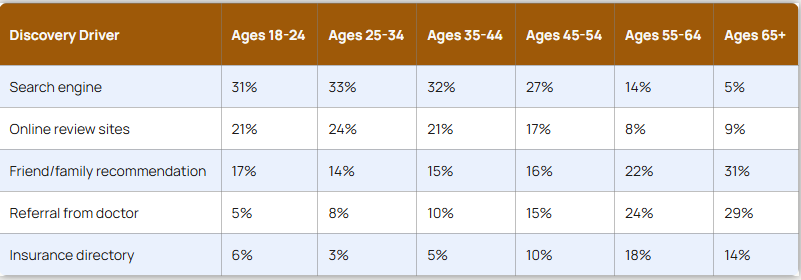
Source: 2026 Healthcare Patient Experience Report
Whether they are looking for a specialist, comparing treatment options, or evaluating providers in their area, search engines have become the primary channel to healthcare information and access.
As a result, healthcare organizations have invested heavily in local search visibility, provider listings, reputation management, and search engine optimization to ensure they can be found when patients are actively seeking care. But visibility alone does not create patient preference.
Why Search Isn't the Whole Story
While search is often where patient intent becomes visible in the data, it is rarely where initial patient consideration begins. Patients are influenced by a range of factors throughout their decision-making journey. Before searching for a provider, patients may have already:
- Seen a television, streaming, or Connected TV advertisement
- Heard a radio or podcast ad
- Noticed out-of-home advertising
- Encountered social media content
- Received a recommendation from a physician, friend, or family member
- Read online reviews or patient testimonials
These brand touchpoints demonstrate why effective healthcare digital marketing services extend beyond search, helping healthcare organizations build awareness, familiarity, and trust long before a search query is typed.
This reality creates one of healthcare marketing's most common measurement challenges. According to Freshpaint's State of Healthcare Marketing in 2026 report, 64% of healthcare organizations identified Google Ads as their highest-performing channel, while Google ultimately closed 58% of conversions that were initially influenced by another marketing channel.
The result is a bias toward the channels closest to conversion. Search often receives credit for the appointment, even when demand was created by awareness-driving activities that occurred days, weeks, or months earlier.
While search engine marketing remains a critical component of patient acquisition marketing, healthcare brands should avoid overlooking the experiences and interactions that influence patients before the search begins.
The Modern Patient Journey
A retail lens offers an important perspective to this. Retail marketers understand that consumers rarely move from awareness to action in a single step. Trust is built through a series of interactions over time. The same principle applies in healthcare, although the stakes are significantly higher.
Patients often:
- Research providers
- Compare treatment options
- Read reviews
- Verify credentials
- Seek referrals
- Evaluate trust signals
Healthcare decisions follow a similar pattern, although they often involve greater emotion, uncertainty, and risk. Patients are looking for proof, reputation, validation, and reassurance throughout the process. This is key in healthcare retail marketing strategies.
As we've discussed previously at Brandience, trust plays a central role in healthcare decision-making. Awareness creates familiarity. Familiarity creates trust. Trust impacts search behavior and decisions. When viewed through that lens, patient acquisition marketing becomes much more than being visible in a Google Search. It becomes a continuous process of relationship building that extends from awareness to experience.
Why Healthcare Organizations Need an Integrated Approach
Retail brands rarely depend on a single channel to drive growth. They build awareness through broad-reaching media. They reinforce confidence through content and engagement. They create convenient paths to purchase when customers are ready to act.
Healthcare organizations should apply similar thinking. The goal is not to market healthcare like retail. Rather, it is to recognize that patients interact with multiple touchpoints before making a decision. An integrated patient acquisition strategy aligns awareness media, digital marketing, patient experience, and measurement into a unified framework.
When organizations evaluate channels independently, they often miss how each contributes to overall performance. When they evaluate the entire patient journey, they gain a more accurate understanding of what drives growth. And the sooner healthcare marketers recognize this reality, the better positioned they will be to build sustainable growth across the entire funnel.
For healthcare organizations seeking sustainable growth, a data-driven patient acquisition marketing agency can help connect every touchpoint from awareness through patient retention.
About the Authors
As Vice President & Media Director at Brandience, Bill Brassine brings deep expertise in franchise, healthcare, retail, and restaurant media strategies and leads with a client-centric, results-driven philosophy. Connect with Bill: https://www.linkedin.com/in/bill-brassine-2513947/
Laura Cerimele is Marketing Manager for Cincinnati-based Brandience, an advertising and marketing agency. She specializes in developing strategic marketing initiatives that elevate brand visibility, strengthen audience engagement, and drive measurable growth. Laura collaborates with marketers, creatives, and business leaders to uncover insights and opportunities that help brands connect more meaningfully with their audiences. Connect with Laura: https://www.linkedin.com/in/laura-cerimele-6a3350180/

.jpg)
.jpg)
.jpg)
.jpg)