.jpg)
A Full-Service Marketing Agency View on “Digital vs. Traditional Media”
Brandience Team
&
No items found.
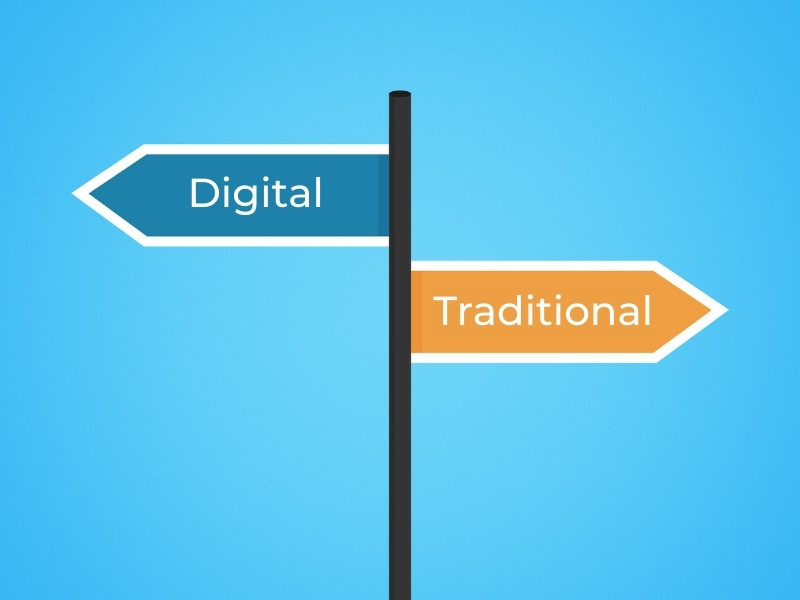
For years, marketers have tried to draw a hard line between “digital” and “traditional” media as if choosing one somehow meant betraying the other. But inside today’s most effective media teams, that tension is a myth. The question marketing teams should be asking is: how do we follow the consumer, wherever they happen to be, with the right mix of precision and reach?
That was the heart of the conversation on our latest Go Beyond episode, where Brandience VP of Media Bill Brassine and VP of Digital Media Danielle Horrillo tackled the “digital vs. traditional” debate head-on. And unsurprisingly, the consensus wasn’t a duel. It was a handshake.
Digital vs Traditional Media
The truth: digital and traditional were never meant to compete.
Simply put, digital is anything delivered via the internet; traditional is anything delivered via pipes, airwaves, or cable. But when you strip away the terminology, they’re just delivery systems, ways to reach people where they spend time.
And people today? They jump nonstop between platforms, channels, and devices. They watch streaming content in the living room and cable at the gym. They hear a radio DJ on their commute and a podcast while they cook dinner.
So why do budgets still compete as if consumers experience the world in silos?
When marketers pit digital and traditional against each other, they end up undercutting the one thing media planning truly demands: a holistic, audience-first strategy.
What Does Today’s Consumer Journey Look Like?
Toss the traditional marketing funnel out the window. Now, it’s a roundabout: a loop that people, and brands, enter and exit at multiple points.
For planners, this means two things:
- Traditional channels (like TV and radio) build broad presence and credibility
- Digital channels add precision, frequency control, and personalization.
It’s not “either/or.” It’s “yes, and.”
Which Marketing Channel Should We Invest More In?
Linear isn’t dying. Streaming isn’t everything. Both matter.
While audiences are shifting, traditional channels aren’t disappearing, they’re evolving. Linear TV still reaches massive audiences and anchors big cultural moments. Streaming platforms, meanwhile, deliver more personalization and 1:1 ad experiences.
- If you’re running video, you should be planning linear and CTV together.
- If you’re running radio, you should be running digital audio alongside it.
That doesn’t mean equal weight. It just means complementary value.
What’s An Emerging Media Channel in 2026?
There’s no denying that there is an emerging (and misunderstood) space: Retail Media Networks (RMNs). RMNs are expected to capture 20.0% of US ad spend by 2029, according to a September 2025 EMARKETER forecast.
“That scale reflects how central retail media has become to both retailers and brands, connecting audiences, data, and commerce in ways that weren't possible just a few years ago,” said EMARKETER analyst Sarah Marzano.
Many non‑e‑commerce brands assume retail media isn’t meant for them, but it’s actually a powerful opportunity. Retailers (like Amazon, Walmart, or Kroger) have something brands desperately need: deep, accurate, first-party shopper data.
For brands without a robust CRM, this is gold. Retail Media Networks (RMNs)offer:
- audiences based on real purchase behavior
- relevance at the moment people are already shopping
- powerful targeting and measurement
RMNs might provide the missing piece in a well-rounded media mix.
Which KPIs Should I Set for My Media Mix?
Yes, digital media delivers deeper attribution than non-digital media. But one can easily get overwhelmed by the sheer amount of data digital platforms generate.
Data is only useful if it drives decisions.
A few practical starting points for an attribution framework:
- Foot traffic studies, perfect when closed-loop sales data isn’t available.
- Correlation analysis, simple, old-school and still incredibly useful for both digital and non-digital tactics.
- Incrementality, a go-to for proving true lift.
A reminder that many brands need: traditional media is measurable. Just not always at the click-level, so choose your KPIs based on objectives, not channel stereotypes.
How Will AI Affect Media Planning and Buying?
AI can help with optimization, research, and efficiency but the “human” aspect of it isn’t going anywhere. AI can’t see a brand’s nuance, or understand context, or judge whether an idea resonates emotionally. It can support decisions, but not make them. Not yet.
As Bill, VP of Traditional Media at Brandience puts it: “Would I trust AI with a whole media budget? Absolutely not.”
Where Is Media Headed in 2026?
The Brandience team sees five clear shifts in the media landscape in 2026:
- More dollars are moving into digital, especially social and streaming. Here are the top 5 social media trends to know for 2026.
- More trust placed in real people, meaning influencer/creator content remains powerful but only when it’s honest.
- More expectation for personalization, which means brands need their data house in order.
- Programmatic increasingly touching “traditional” channels like radio and out-of-home, creating even more blend between what once were separate worlds.
- Media planning is getting more complex but also more exciting.
Stop asking “digital or traditional?” Start asking “what works together?”
The best brands aren’t choosing sides. They’re choosing alignment:
- alignment with the consumer
- alignment with data
- alignment with objectives
- alignment across channels, teams, and tactics
When you stop treating digital and traditional as rivals, you finally build a plan that reflects real human behavior, not your internal budget categories.
Practical Questions to Improve Your Next Media Plan
Here are three questions to ask in every media planning session:
- Where is the audience truly spending time and how fragmented is that attention?
- What combination of channels can reach them broadly and reinforce the message with precision?
- What data do we actually have and what can we realistically measure?
If your team can answer those questions, the digital vs. traditional debate becomes irrelevant.
About the authors:
As Vice President & Media Director at Brandience, Bill Brassine brings deep expertise in franchise, healthcare, retail, and restaurant media strategies and leads with a client-centric, results-driven philosophy. Connect with Bill: https://www.linkedin.com/in/bill-brassine-2513947/
Danyelle Horrillo, VP of Digital and Programmatic Media at Brandience, is a motivated, results‑driven media professional with experience leading high‑performance, data‑driven campaigns. Danyelle brings a rare blend of technical expertise, strategic insight, and relentless dedication to results. Connect with Danyelle: https://www.linkedin.com/in/danyellehorrillo/

.jpg)
.jpg)
.jpg)