
Viral-Ready Social Media Tips from a QSR Marketing Agency
Kenna Abner
&
.jpg)
No items found.
Every brand wants to go viral. And honestly, who can blame them? In QSR social media, those results are rarely random. Behind the content that rises to the top of the feed are clear patterns in how audiences respond, engage, and share. What are the top social media trends of 2026?
Through building social strategies and analyzing campaign performance across QSR brands, we have seen what consistently drives visibility and engagement. These are not assumptions, but observations grounded in real campaign results.
Here’s what is really driving viral-ready social media content for restaurant brands in 2026.
Social Media Tips for Restaurant and QSR Brands: What Makes Social Media Content “Go Viral”?
1. Use Emotion That Drives Social Shares
Emotion has always been the driving force behind viral social media content, regardless of how platforms or algorithms change. Content that makes people feel something is far more likely to get shared. It does not have to be a highly produced moment or viral stunt. It just has to spark a genuine reaction, whether that is joy, nostalgia, warmth, excitement, or even a little friendly debate. When people feel connected to what they are watching, they naturally want to pass it along.
That emotional connection is already built into the QSR experience in a natural way. Customers are not just craving the food itself, they are craving what comes with it: the Friday night tradition, the comfort meal after a hard week, the excitement of a limited-time only (LTO) item finally hitting the menu. Tapping into these everyday feelings is one of the most effective things a brand can do for its restaurant social media presence and overall QSR brand awareness.
An Academia study found that emotionally driven content earns significantly more shares than posts that are purely informational, which aligns with what we see consistently across restaurant brands we support.
2. Let Your Brand Personality Shine
Humor is one of the most underrated tools in QSR social media marketing. A funny post does not just collect likes. It gets screenshotted, shared to group chats, stitched, and talked about, extending your reach well beyond your existing followers. And the good news for QSR brands is that there’s often more room to be playful on social than most realize.
The brands that that use humor successfully are not trying to run a comedy account. Instead, they let their brand voice come through naturally in the content they are already making. This is especially important when creating platform-native social content that matches audience expectations on each channel.
Wendy’s is a great example of using humor in their social presence. They built one of the most engaged brand accounts on social media by having a consistent point of view and using it confidently.
For QSR brands on TikTok and Instagram, these humor approaches tend to perform especially well:
- Say what your audience is already thinking, just faster
- Turn everyday customer behavior into content
- Lean into your “known truth” as a brand
- Embrace content that is authentic, even slightly imperfect
3. Controversy that Becomes an Opportunity
Controversy can play a powerful role in a QSR social media strategy when it is handled thoughtfully. The sweet spot is finding whether your brand fits naturally.
A widely discussed example of this in the QSR social space in 2026 was McDonald’s Big Arch launch. McDonald’s CEO Chris Kempczinski posted a taste-test video that was meant to be a standard product launch, and it quickly became one of the most talked-about clips all year. Viewers picked up on the small, hesitant bite and the repeated use of “the product” instead of something more natural, which sparked commentary and major reactions. The post hit nearly 11 million views on Instagram, with brands jumping into the conversation publicly.
What resonated with people was not the controversy itself, but the feeling that the content didn’t feel authentic, and that is a lesson worth keeping in mind for any brand creating social content.
A strong example of controversy handled well is when regional QSR chain Skyline Chili joined the conversation. Skyline’s CEO Dick Williams created a taste test of a Coney that felt completely natural and true to the brand. The content tied directly to something the audience genuinely cared about: the announcement of Free Coney Day for Reds Opening Day. It moved quickly, matched the energy already building online, and gave fans something meaningful to respond to.
That moment highlights how QSR brands can find their place in cultural conversations in a way that feels completely true to who they are.
Should QSR brands be looking for trending moments to participate in?
It depends on whether the trend genuinely fits the brand. Jumping into a trend moment that has no meaningful connection to your brand usually shows and audiences can tell when participation feels forced. However, when a conversation is already gaining traction in your category and your brand has something authentic to add, showing up quickly and thoughtfully can drive engagement and reach for QSR brands.
4. Timing and Cultural Relevance
Timing and cultural relevance are two of the more challenging parts of a QSR social media strategy, but when brands get it right, it can be extremely rewarding.
Social media moves fast, especially on platforms like TikTok where trends can peak in as little as 3 to 5 days and fade just as quickly. Increasingly, social platforms also serve as discovery engines, with consumers using social channels to find restaurants, products, and recommendations.
The Sprout Social Index found that 27% of consumers believe a trend is only effective within the first 24 to 48 hours of its lifespan, which means the window to participate is smaller than most brands realize.
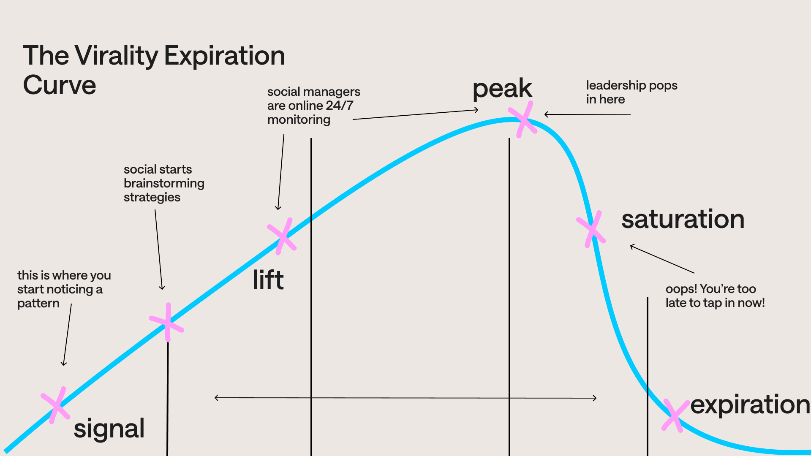
Audiences are quick to notice when a brand is showing up in a conversation just to be seen, versus showing up because they genuinely belong there. The goal is to shape culture, not just chase it.
What tends to work best is finding the moments that connect naturally to your brand identity and what your audience already cares about. For QSR brands, that calendar is genuinely rich: local sports seasons, community events, limited-time only (LTO) menu launches, food holidays, and regional moments that your audience already has strong feelings about. Planning for these moments in advance puts your social team in a position to execute thoughtfully when the moment arrives rather than scrambling to catch up.
If you’re refining your approach to restaurant social media marketing, Brandience’s award‑winning QSR social media strategy helps brands turn cultural moments into meaningful engagement.
Keep Showing Up for Your Social Audience
The restaurant brands that are winning on social media right now are the ones showing up consistently with content that feels real, authentic, and a genuine awareness of the moments their audience cares about.
We are excited to see how QSR brands continue to build on their social media strategies in 2026.
From organic social video to paid social campaigns, our work proves that authenticity and timing drive results. Explore Brandience’s latest QSR case study to see how strategy turns into real performance or connect with our team to identify the biggest opportunity for your brand.
About the author:
Makenna (Kenna) Abner is a Social Media Content & Community Management Specialist at Brandience. She works closely on quick‑service restaurant social media strategies, creating engaging content and fostering authentic community connections. Connect with Kenna: https://www.linkedin.com/in/makenna-abner/
.jpg)
.jpg)

.jpg)
.jpg)