








TriHealth
Life‑Stage Messaging Elevating Women’s Health Engagement
Healthcare Marketing & Branding Agency
Great creative coupled with data-driven decision-making.
Rob Whitehouse, Vice President of Marketing & Communications
TriHealth
Great creative coupled with data-driven decision-making. The best agency I've worked with in my career.
Rob Whitehouse, Vice President of Marketing & Communications
TriHealth


The Challenge
TriHealth is a leading health care system in Cincinnati, Ohio with 40+ sites and more than 100 providers specializing in women’s health care. Its Women’s Services represent one of the system’s largest and most important patient groups: women seeking care from adolescence through menopause and beyond.
As TriHealth continued expanding its provider network and reaffirming its commitment to lifelong women’s health, they partnered with Brandience, a full-service marketing agency, to help shape, implement, and optimize an ongoing media campaign built to engage a diverse, multigenerational audience.
The opportunity was to build a campaign that strengthened TriHealth’s position as the region’s leading provider of comprehensive women’s health care.
The Objective
Increase awareness and consideration of TriHealth’s Women’s Services. Reach women across all key stages of life and reinforce TriHealth’s broader brand promise.
The Campaign
Brandience partnered with TriHealth to develop an integrated Women’s Services campaign built around the idea that every woman’s journey is unique and TriHealth supports all of them.
- Life‑Stage Messaging: Designed creative variations aligned to key stages of a woman’s life.
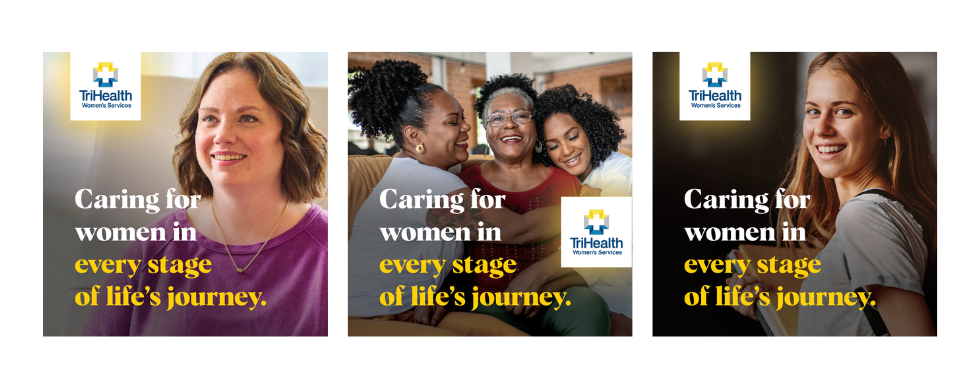
- More Women Choose Messaging: Paired life‑stage creative with proof‑based messaging that highlighted TriHealth as a leading provider of women’s health services in the region.

- Targeted Media: Deployed targeted non-digital media and digital media including out of home, radio, paid social, and digital display and audio strategically matched to each audience segment

- Optimization: Ongoing optimization for digital media to consistently exceed high‑benchmark engagement and CTR performance.
- Message Alignment: Maintained oversight of all in‑market messaging to ensure campaigns complemented each other and strengthened overall brand impact.
The Results
The campaign delivered strong month‑over‑month momentum, generating millions of impressions and strong performance across every targeted audience group.
Performance was measured through increased engagement and click-through performance across all digital and social media tactics. Across every measurable digital tactic, the campaign outperformed established benchmarks, particularly in engagement and click‑through rate, most notably exceeding paid social engagement benchmarks by almost 3X.
Grow Your Impact
If you’re ready to stop settling for industry averages and start shattering benchmarks, let’s build your next success story together.In a crowded landscape, connecting with healthcare consumers requires relevance, clarity, and precision. As a specialized medical marketing agency, we help healthcare brands turn smart strategies into measurable breakthroughs by combining industry expertise with data-driven precision. If you’re ready to raise the bar, we’re your healthcare marketing partner. Connect with us today!

Capabilities
No items found.
Common Questions
How does a retail mindset improve patient acquisition?
A retail mindset helps healthcare organizations better understand how modern patients make decisions. Patient expectations are shaped by the convenient, transparent, and personalized experiences they encounter every day. Applying a retail mindset means recognizing that patients expect information to be accessible, decisions to be easier to navigate, and care to be easier to access. By reducing friction, improving visibility, and creating patient-centered experiences, healthcare organizations can build familiarity, strengthen trust, and improve patient acquisition across the entire journey.
What influences patient decisions before they search for a provider?
Patients are influenced by many touchpoints before they begin actively researching care options. Advertising, physician referrals, online reviews, patient stories, social media content, prior experiences, and word-of-mouth recommendations all contribute to awareness and trust. Because healthcare decisions often involve uncertainty and emotion, patients seek validation from multiple sources before choosing a provider. Building visibility and trust before the search occurs is a critical component of patient acquisition marketing.
How can healthcare organizations improve patient acquisition?
Healthcare organizations improve patient acquisition by making it easier for patients to discover, understand, and access care throughout the decision-making process. Patients rarely choose a provider after a single interaction. Instead, trust is built through a series of touchpoints, including:
- Advertising that builds awareness and familiarity
- Content marketing that educates and answers patient questions
- Search visibility that helps patients find care when intent is highest
- Online reviews and testimonials that provide validation and reassurance
- Referrals from physicians, family, and friends
- Patient experiences that reinforce trust and encourage loyalty
An effective patient acquisition strategy combines clear messaging, strong service line visibility, patient-centered content, and a seamless path to care. By creating awareness, building confidence, reducing friction, and delivering positive patient experiences, healthcare organizations can support sustainable growth across the entire patient acquisition funnel.
How do patients choose healthcare providers?
Patients choose healthcare providers through a series of interactions that build awareness, familiarity, and trust over time. While many patients eventually search online for providers, read reviews, compare treatment options, and evaluate credentials, those actions are often influenced by touchpoints that happened much earlier. A patient may have seen an advertisement, received a physician referral, encountered social media content, heard a recommendation from a friend, or had a previous experience with the organization.
Healthcare decisions are often emotional and high-stakes, so patients look for reassurance, validation, and confidence throughout the process. The healthcare organizations that earn consideration are those that consistently create trust across the entire patient journey, from initial awareness to scheduling and care delivery.
What is the patient acquisition funnel?
The patient acquisition funnel is the series of stages patients move through as they discover, evaluate, choose, and engage with a healthcare provider. While many organizations focus on the moment a patient searches for care, the journey often begins much earlier with awareness-building activities that create familiarity and trust. A complete patient acquisition funnel includes:
- Awareness: Building familiarity with your organization before a need arises.
- Consideration: Helping patients evaluate their options and build confidence in your brand.
- Search: Capturing patient intent when they actively research providers or services.
- Scheduling: Removing friction and making it easy to take the next step.
- Care Experience: Delivering on the promises made through marketing and communications.
- Retention: Strengthening patient relationships and loyalty.
- Referral: Earning advocacy through positive patient experiences and reputation.
Each stage plays a role in helping patients build confidence and move forward with care, making patient acquisition a continuous process rather than a single marketing event.
What makes employee-generated content (EGC) so effective?
EGC builds trust and authenticity by showcasing real people behind the brand. Day-in-the-life videos, behind-the-scenes moments, and personal stories create a human connection that polished brand content alone cannot achieve, making EGC a powerful engagement tool.
How can brands optimize social content for SEO and GEO?
Brands should use clear, natural language in captions, incorporate relevant keywords, and align visuals with text. Spoken phrases in videos matter too, as AI-powered search indexes audio. This approach ensures content is discoverable across social platforms and AI-driven engines.
Why is video still important for social media in 2026?
Video remains the leading format because it captures attention quickly and delivers value fast. Short-form videos and micro clips are especially effective, as they align with user behavior and platform algorithms that prioritize snackable, engaging content.
What are the top social media trends for 2026?
The biggest trends shaping social media in 2026 include micro video clips, community-driven engagement, SEO and GEO optimization for social search, series-based content, and employee-generated content (EGC). AI also plays a major role as both a creative and strategic tool.
What’s the best media mix for brands?
A balanced funnel approach: traditional for awareness, digital for conversion. Start broad, then retarget with precision.
How can I measure the impact of my traditional ads?
Use hybrid tactics: QR codes, unique URLs, promo codes, and cross-market testing. Combine these with digital analytics to attribute traffic and conversions accurately.
Is traditional media still effective in 2025?
Yes. According to Nielsen and PewResearch.org, TV and radio remain top channels for brand trust and mass reach, especially when integrated with digital media for measurable ROI.
What’s a common mistake brands make when it comes to brand creative?
Ignoring context; using the same creative across every channel instead of optimizing for audience attention and dwell time.
How does Brandience adapt design across platforms?
Through objective and tactical alignment upfront. Then, we tailor visuals, copy, and pacing for each medium’s audience.
Why is creative consistency important?
Consistency strengthens recognition and trust. Repetition of core brand elements helps audiences connect emotionally and cognitively faster.
What does “designing with context” mean?
It means creating marketing assets intentionally for their environment like digital, print, outdoor, or in-store so they resonate in the exact moment and mindset of the audience.
How does my retail brand stand out in a crowded market during the holidays?
To stand out to consumers during the holiday season, focus on relevance, value, and seamless experiences. Use AI and personalization to reengage shoppers who showed intent but didn’t convert.
Is mobile really that important?
Absolutely. According to EMARKETER, mobile now drives over 50% (56.5%) of ecommerce sales and influences in-store decisions.
How will inflation affect holiday shopping in 2025?
NRF projects inflation (PCE) will hover around 2.5% this year. While that, along with tariffs, is weighing on consumer sentiment, household finances remain stable. Retailers should expect cautious but steady spending with stronger growth in ecommerce than brick-and-mortar.
Should I still invest in Black Friday?
Yes, but don’t rely on it. Spread promotions throughout October and November to catch early shoppers.
Case studies
More of our work
Insights
More great content
.jpg)
.jpg)
.jpg)

Bill Brassine